
25 Nov Salamander vs. Cheesemelter: What’s the Difference?
A perfectly seared steak, bubbling melted cheese, a beautifully caramelized topping. Making sure these finishing touches are on point requires the right equipment. Two popular options in commercial kitchens are salamanders and cheesemelters. Both use overhead heat to deliver results, but they’re designed with different priorities.
A salamander broiler is generally designed for more intense browning, searing, and caramelization, while a commercial cheesemelter focuses on melting toppings and finishing prepared dishes.
Which deserves a place in your kitchen? Here’s how to choose the best fit for your menu and workflow.
What Is a Salamander Broiler?
A salamander is a specialized broiler that uses intense overhead infrared heat to brown, sear, or caramelize. By concentrating heat on the exposed surface, it develops color, texture, and flavor extremely quickly, without unnecessarily cooking or drying out the interior of the dish.
Common salamander applications include:
- Browning gratins: Developing crisp, flavorful crusts on potatoes, pasta, and vegetable dishes.
- Searing or Finishing proteins: Adding surface color and browning to steaks, fish, and lobster.
- Caramelizing toppings: Bringing out rich flavors in crème brûlée, glazed fruit, and onion-topped flatbreads.
- Melting and browning cheese: Creating bubbling, golden toppings on lasagna, omelets, and stuffed mushrooms.
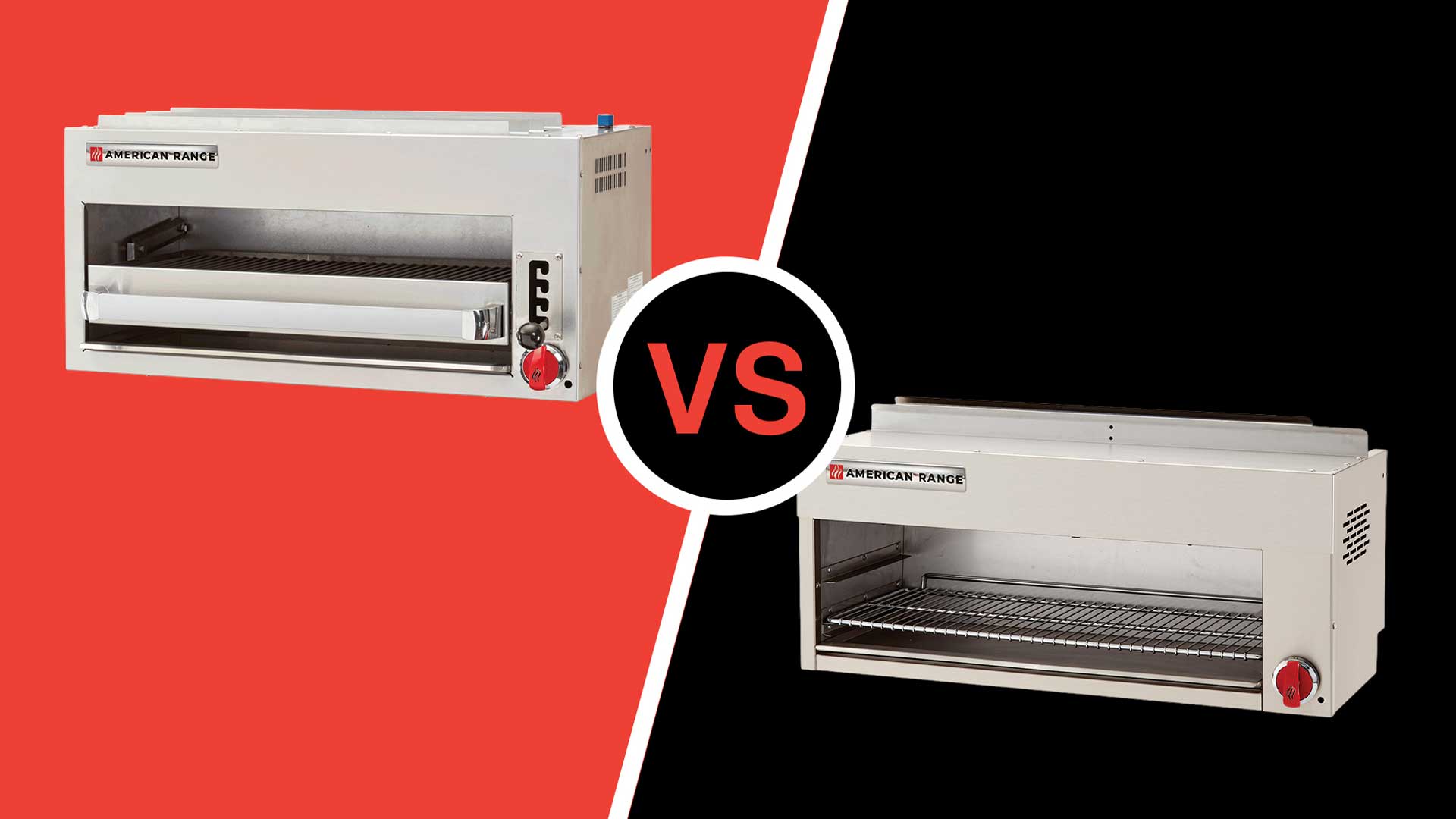
Many commercial salamanders feature an adjustable cooking grate: positioning food closer to the overhead heat produces more aggressive browning, while greater distance allows gentler finishing. American Range offers the single-control ARSM-36 salamander, featuring a four-level adjustable cooking grate, and the dual-control ARSB-36 with two independently controlled infrared burners and a four -level adjustable grate. Both models feature removable cooking grates.
There is some overlap between salamanders and cheesemelters, particularly when it comes to melting and browning cheese. But a salamander’s ability to handle those tasks alongside more intensive searing and caramelization generally makes it a more versatile option for kitchens looking to accomplish a wider range of finishing techniques with one appliance.
Why “salamander”? Before modern salamander broilers, chefs used a long-handled iron plate heated in fire and held over food to brown its surface. Some versions featured a long body and supporting legs. The tool’s unusual name is believed to come from the lizard-like salamander, which legend claimed could survive fire.
What Is a Cheesemelter?
Unlike the salamander, the cheesemelter has a much more straightforward name. It’s named for its main job: melting cheese. Like a salamander, it uses overhead infrared heat, but it’s primarily intended to melt cheese and gently brown toppings, rather than deliver the more intense browning and searing associated with salamanders.
Popular applications include:
- Open-faced sandwiches: Melting cheese over hot sandwiches.
- Loaded baked potatoes: Heating cheese and toppings.
- Nachos: Melting cheese across prepared servings.
- French onion soup: Creating a bubbly, golden finish on the cheese topping.
- Casseroles and entrées: Finishing with melted or lightly browned cheese.
For kitchens turning out a steady stream of such dishes, a dedicated cheesemelter provides a convenient station for melting and browning toppings, freeing up other cooking equipment. American Range’s infrared cheesemelters are available in 24-, 36-, 48-, 60-, and 72-inch widths to accommodate different kitchen layouts and production demands.
Salamanders and Cheesemelters: Key Considerations
As you consider your kitchen’s needs, here are three key factors to keep in mind.
1. Cooking Applications
Salamanders offer versatility and control for everything from melting cheese all the way to deep browning, searing, and caramelization, making them well suited to menus featuring gratins, seafood, steaks, and other dishes requiring intense surface heat.
Cheesemelters are designed specifically for frequent melting and lighter browning tasks, offering a simpler, typically more economical option for kitchens regularly preparing cheese-topped dishes, from sandwiches and appetizers to casseroles and entrées.
The best choice depends on the finishes your menu requires most often.
2. Heat Control and Food Positioning
Salamanders commonly have adjustable grates to control the distance between food and the heating element. This gives kitchens flexibility to achieve different levels of browning and searing across a variety of dishes. Some models, such as American Range’s ARSB-36, also feature independently controlled infrared burners for more precise control over heat intensity.
Cheesemelters generally emphasize straightforward, repeatable finishing, although rack and heat-control arrangements vary by model. American Range’s ARCM series features two-position rack guides and individual burner controls, providing simple adjustments for consistent melting and browning.
3. Kitchen Space and Installation
Both appliances can be wall-mounted or range mounted, making use of vertical kitchen space. American Range offers mounting configurations for cheesemelters and salamanders that integrate with specified restaurant ranges.
Consider clearance, ventilation, loading access, and proximity to cooking stations, and always confirm installation requirements and mounting compatibility for specific models.
Salamander or Cheesemelter: Which Is Right for Your Kitchen?
The decision starts with your menu and workflow.
Choose a salamander when:
- Frequent browning, searing, or caramelization is required.
- The kitchen uses heat to finish a wide variety of dishes.
- One station must accommodate multiple finishing techniques.
Consider a cheesemelter when:
- Melting cheese is a frequent task.
- Your menu emphasizes sandwiches, nachos, soups, and topped entrées.
- You need a dedicated melting and browning station.
Production volume matters, too. Some high-volume kitchens may benefit from both appliances, using a salamander for high-heat finishing and a cheesemelter for frequent cheese-topped orders. Whether both earn a place in the kitchen depends on menu demand, station layout, and service volume.
Explore American Range’s cheesemelters and salamanders to compare equipment options and find the right fit for your commercial kitchen.